The Cornerstone of the Digital Universe: Transistor Wars, the Rise of Artificial Intelligence, and the Future of Technology
Hello, welcome to my first blog. I'm planning to share blog posts on my site from time to time. If you want me to start a newsletter, just reach out.
Introduction: The Power of the Invisible Engine
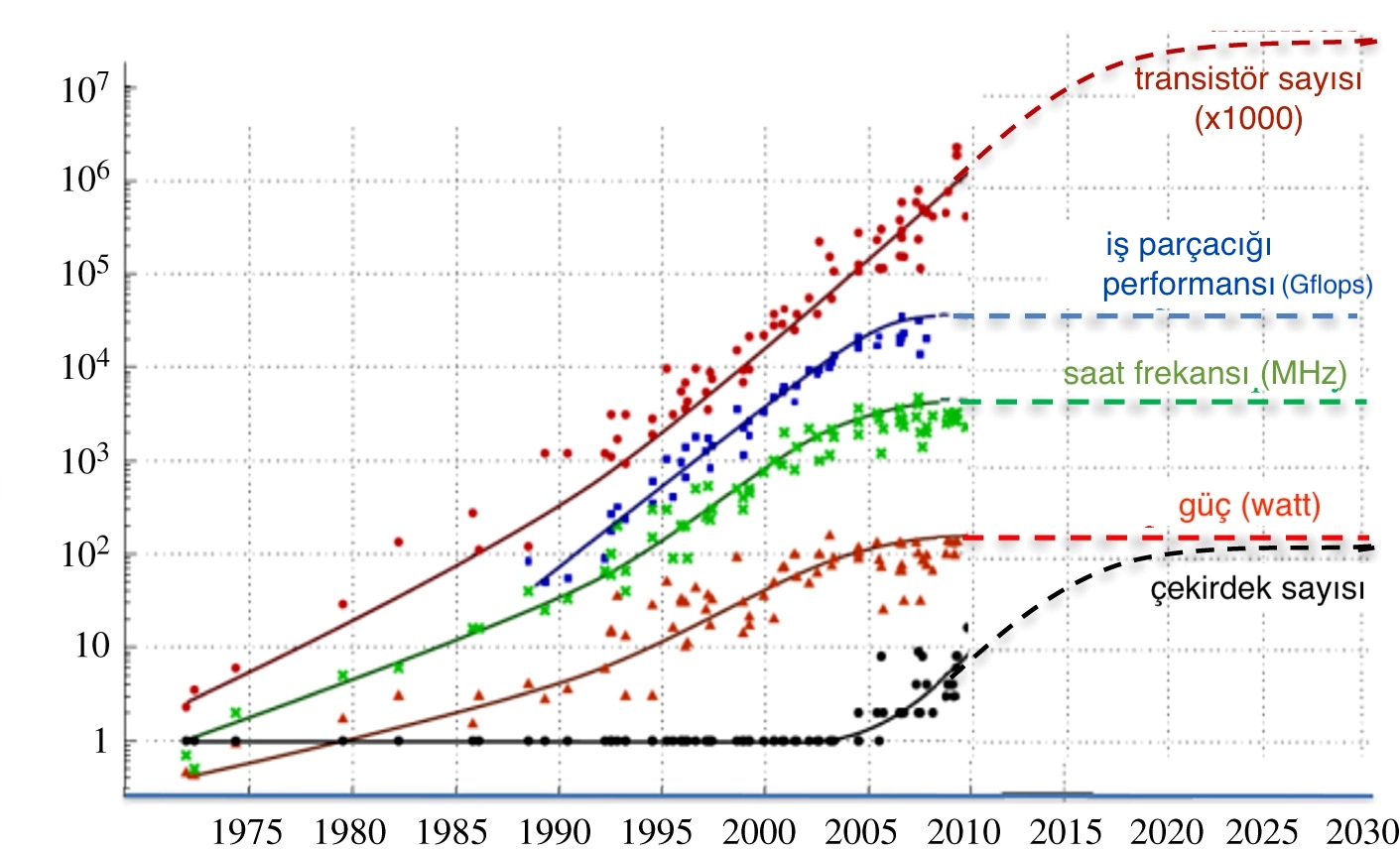
The technology that powers every moment of modern life, from the smartphone in our pocket to the laptop on our desk and the data centers in the cloud, can seem like abstract magic. While navigating the fluid interface of a device equipped with Apple's M4 processor or marveling at the capabilities of an AI application powered by Nvidia's latest GPU, it's easy to overlook the tangible source of this power. However, at the heart of these digital experiences lies an invisible engine, tens of thousands of times smaller than a human hair: the transistor. These microscopic switches are the fundamental building blocks of the digital revolution and uphold all of modern electronics. For example, inside the Apple M4 processor, exactly 28 billion transistors switch on and off trillions of times per second to execute our commands. For more than half a century, a guiding principle has set the pace of development for this microscopic world: Moore's Law. This law predicted that the number of transistors on a chip would roughly double every two years, imposing a relentless pace of progress on the technology industry.
In this article, we will delve deep into the forces behind this relentless progress, the technologies that make it possible, and the challenges shaping its future. The main players on this stage are TSMC, the master foundry producing the world's most advanced chips; Apple, the architect of efficiency and integration; Nvidia, the champion of raw processing power; and artificial intelligence, the insatiable consumer of all this power. As we approach the physical limits of silicon in this critical era, the tech world faces a fundamental question: Is the age of exponential growth coming to an end, or is it merely transforming into something new and more complex?
So, What is TSMC?
TSMC stands for Taiwan Semiconductor Manufacturing Company Founded in 1987 by Morris Chang, this company revolutionized the technology industry.
How? By inventing the "pure-play foundry" model.
Let's explain what this model means with a simple analogy:
- Designers (Fabless): Think of companies like Apple, Nvidia, AMD, and Qualcomm. They are like incredibly talented architects. They design. every detail of the house (the chip)—how many rooms it will have, how much energy it will consume, and how fast it will be. However, they don't have their own construction crews (factories).
- Manufacturer (Foundry): This is where TSMC comes in. TSMC is the world's most advanced construction firm. It takes Apple's blueprint (design) and turns it into a physical house (a chip)
The reason TSMC is called "pure" is that it does not design and sell chips under its own brand. They have only one job: to manufacture their customers' designs with the most advanced technology and the highest quality possible.
This business model allowed companies like Apple to avoid the billion-dollar cost of building a factory and to dedicate all their focus solely on making the best design.
What Makes TSMC So Important?
For a company to be "important," it's not enough to just be big; it must also be irreplaceable. TSMC is exactly that.
Moore's Law: The Industry's Self-Fulfilling Prophecy
Now, let's return to Moore's Law. Although often perceived as a law of physics, Moore's Law is actually the product of a powerful economic and industrial observation that has guided the course of the technology industry. Over time, this "law" transformed into a self-fulfilling prophecy, drawing the roadmap for the entire semiconductor sector.
The Origin and Evolution of Moore's Law
It all began in 1965 with an article published in Electronics Magazine by Gordon Moore, one of Intel's co-founders. Moore observed that the number of components on integrated circuits was doubling approximately every year and predicted this trend would continue for at least another ten years. Moore updated this observation in 1975, revising this period to "every two years." Although he himself never called this observation a "law," the phrase became the golden rule of the tech world.
The Economic Engine
The genius of Moore's Law lies not only in its technical foresight but also in its inclusion of a powerful economic principle. The law predicted not only that the number of transistors fitting into a unit area would increase exponentially, but also that the cost per transistor would steadily decrease. This dual effect ignited the economic engine that allowed technology to become both more powerful and more accessible. As computers became more powerful, their prices dropped, enabling technology to move out of laboratories and into our homes and pockets.
The Self-Fulfilling Prophecy
Moore's prediction quickly evolved from an observation into a target and a competitive benchmark for the industry. Semiconductor manufacturers understood they had to keep up with this pace because they knew their competitors were investing billions in R&D toward this goal. This situation turned Moore's Law into a prophecy: the industry made the investments that would validate the law precisely because it believed the law would hold true. The slowing of this prophecy is not just a technical challenge; it is a profound business model crisis. The corporate strategies of tech giants, their product cycles (a more powerful iPhone every year), marketing promises, and investor expectations have been built upon this predictable, exponential performance promise for decades. If a company cannot deliver a product twice as powerful in two years, how can it justify new models and high price tags? Therefore, reaching the limits of Moore's Law is more than just a technical problem for engineers; it is an existential issue threatening the economic model of the entire tech industry. This is the fundamental reason why companies are aggressively pursuing alternative paths to performance improvement, such as chiplets and new architectures. The issue is not just about making faster chips; it is about preserving the economic model that has fueled the technology industry for 50 years.
Dancing on the Atomic Frontier: The Evolution of Transistor Technology
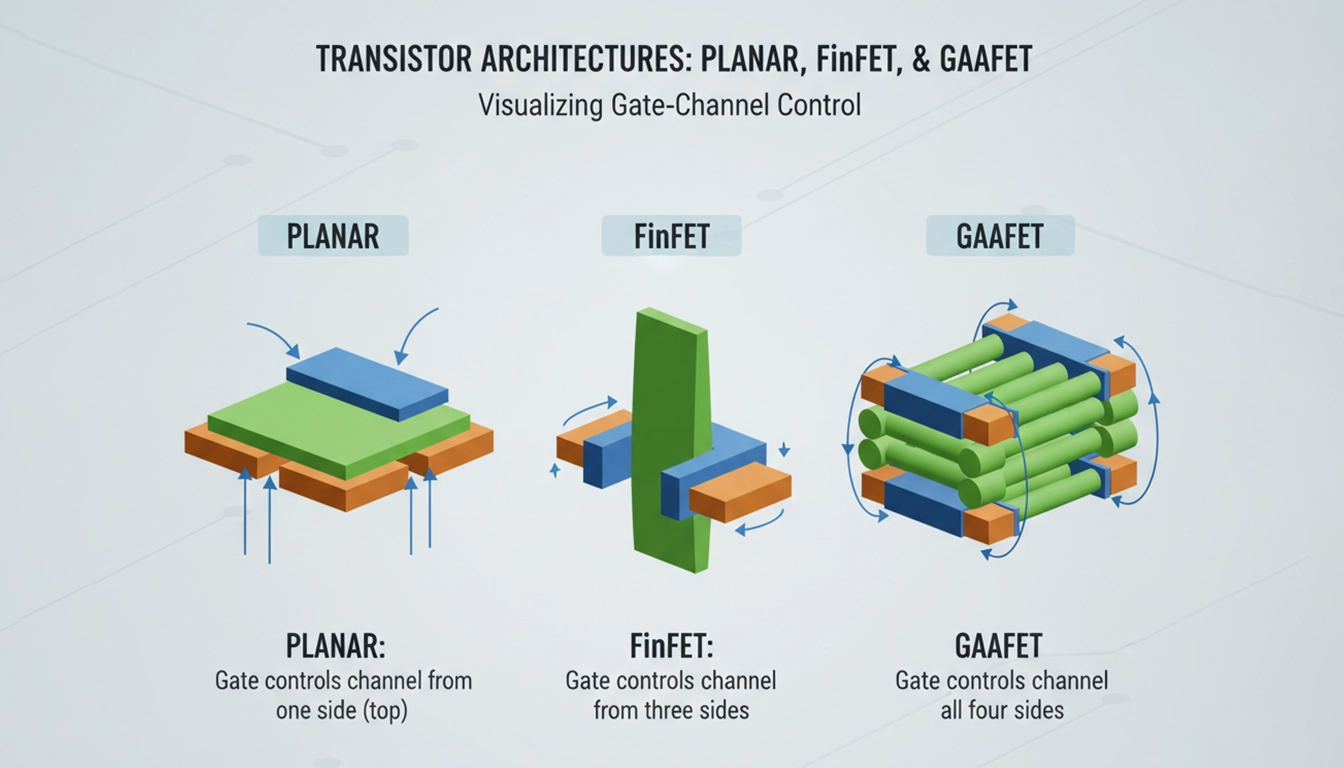
To sustain the breakneck progress predicted by Moore's Law, transistors themselves had to undergo a fundamental evolution. The transition from two-dimensional planes to three-dimensional architectures was the most critical technological leap that ensured the law's continuity in the modern era. Today, however, to descend to 3-nanometer nodes and below, a new evolutionary step has become inevitable.
Comparison of Transistor Architectures
| Technology | Architecture | Key Advantage | Main Limitation |
|---|---|---|---|
| Planar FET | 2D (Gate on top) | Basic control | High leakage at small nodes |
| FinFET | 3D (Gate on 3 sides of the "fin") | Improved electrostatic control | Limited control below 5 nm |
| GAAFET (Nanosheet) | 3D (Gate on 4 sides of the "nanosheet") | Superior electrostatic control | Manufacturing complexity |
Summary
In this section, we discussed the importance of transistors, which form the foundation of the modern digital world, and Moore's Law, which has guided the technology industry for half a century. We examined how Moore's Law transformed from merely a technical observation into an economic engine and a self-fulfilling prophecy that shapes the industry. We detailed the critical evolution of transistor architecture—from two-dimensional Planar designs to three-dimensional FinFET and ultimately to GAAFET structures that maximize control at atomic limits—in order to overcome the physical challenges of sustaining this breakneck progress.
Author & Contact
Date Published: November 12, 2025
Author: Kerem Uysal
Contact: [email protected]